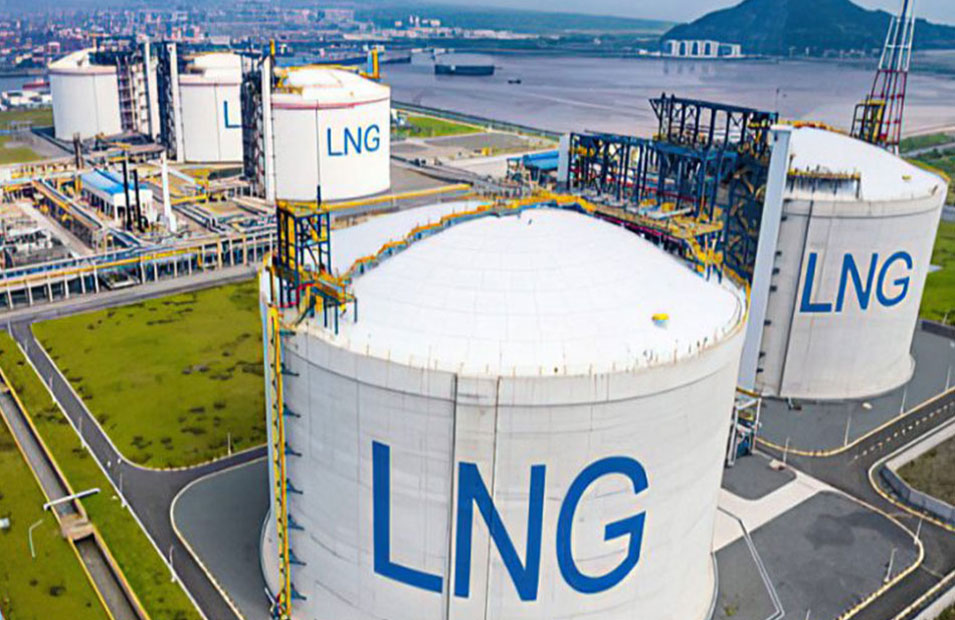
Coil wound heat exchangers are used in the process industries for heating or cooling fluid streams at high heat transfer rates which require large heat transfer areas. Coil wound heat exchangers, also known as spiral wound or spool wound heat exchangers, are particularly useful for cooling and condensing high pressure gas streams. In the production of liquefied natural gas (LNG), for example, large surface areas are required for the indirect transfer of heat between refrigerants and the pressurized feed gas, which is cooled from ambient temperature to yield LNG at temperatures near -162°C (-260°F) Coil wound heat exchangers are ideally suited for use in LNG process cycles at cryogenic conditions.
Coil wound heat exchangers utilize tubing bundles constructed of large numbers of long tubes which are helically wound about an axial central core or mandrel. Numerous tube layers are formed in the radial direction, each layer being separated from adjacent layers by axial spacers or spacer wires. One or more bundles can be installed in a pressure vessel with appropriate headers and piping for introducing streams to be cooled into the tubes and withdrawing cooled liquefied streams from the tubes. Additional piping is used for fluid flow between bundles. Refrigeration typically is provided in these exchangers by mixed refrigerants vaporizing on the outer side, or shell side, of the tubes.